
Find Pleasant Prairie Residents
Start with the fact you already hold. A street address leads straight to the county property roll and parcel map. A full name can be tested against a deed party, a Wisconsin court case, a state credential, or a business filing. Older names and rural routes belong to the archive trail instead. Every match is a dated observation, not a full Pleasant Prairie household roster.
The best residents directory result ties two clues from separate sources. An assessed owner may live somewhere else entirely. A tax mailing address may point to an agent, a trust, or an estate. A voter lookup answers one registration question and never reveals ballot choices. Old directories only reflect what a publisher collected for a single edition. Keep those roles apart as the resident lookup moves along.
- Enter the exact situs address in Kenosha County Property Inquiry, then save the parcel number and legal description.
- Check Wisconsin MyVote by name and birth date for your own voter profile, or use its address mode for polling geography.
- Search LandShark by party name and legal description, using more than one spelling or search route.
- For an earlier household, compare a directory year with a census, plat, newspaper, or obituary.
- Ask the named custodian for an existing file when no public index answers the question.
Pleasant Prairie Records Custodians
Pleasant Prairie is a village, not a city. The Village office is just one piece of the local record system. Assessment Services keeps land and building facts for most local parcels. Kenosha County preserves deeds and runs the county property and mapping services. Election records sit with the Village Clerk, the County Clerk, and the Wisconsin Elections Commission. Court files answer to their own custodians. The split matters. A broad records request sent to the wrong desk can miss the document entirely.
The offices listed here are the main starting points for the Pleasant Prairie residents directory. For a whole-road approach, turn to the Pleasant Prairie street directory after pinning down the right parcel source. That page groups results street by street.
Village Assessment Services
9915 39th Avenue
Pleasant Prairie, WI 53158
262-925-6707
Start Pleasant Prairie Directory With Parcels
The Kenosha County Property Inquiry is the strongest bridge from an address to a parcel. Its public landing screen asks for a Guest Sign In and acceptance of terms. The live controls appear after both. County materials document lookups by parcel number, property address, common location, and owner. A parcel card may carry the situs address, the assessed owner, the tax mailing address, values, tax and sale data, and building facts. It may also carry a GIS link. Save the parcel number once it appears. That number connects the record to mapping and deeds without leaning on a name alone.
Keep the two address fields distinct. Situs is the physical parcel. Mailing is wherever the owner wants tax correspondence sent. A mismatch can be a useful clue, but it proves nothing about occupancy. Treat the owner line in any residents directory entry as legal and tax evidence only. The Property Inquiry guest screen displays the terms gate that stands before the parcel controls.
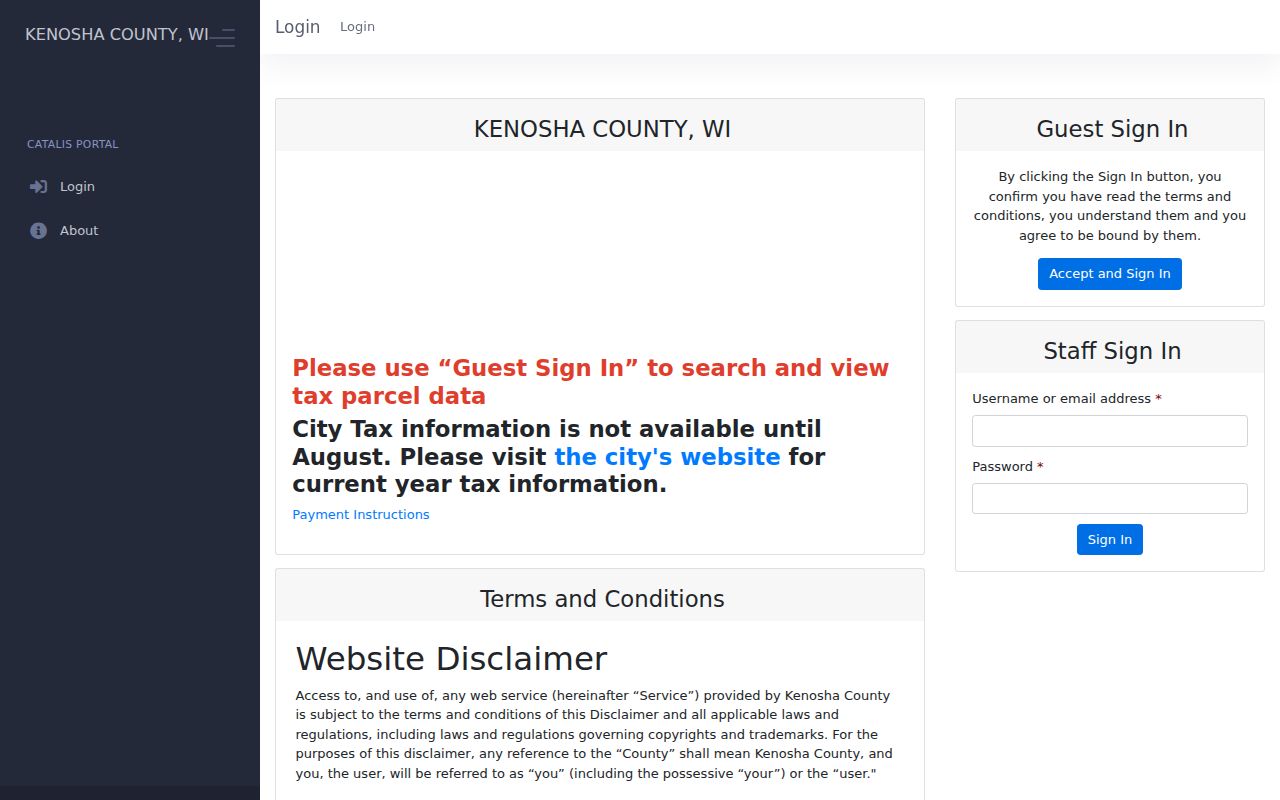
Once terms are accepted, copy down the displayed parcel number right away. It ties the record to mapping and deeds without any need for a name.
Map Pleasant Prairie Resident Records
Geography answers questions a name search cannot. Kenosha County Interactive Mapping layers parcels, address points, roads, buildings, PLSS sections, zoning, floodplain, voting districts, school districts, soils, water, aerial photography, and Pleasant Prairie zoning services. All of it sits on one view. Click a parcel and note its county identifier and legal context. Then carry that detail back into the property or deed system. The county describes the map as a reference compilation rather than a recorded survey. Treat it as a guide, not a legal document.
Map-first searching solves common Pleasant Prairie problems. A rural record may list a section and post office instead of a modern street. A delivery ZIP can cross a legal boundary. A current district layer may not match an old plat. Floodplain or PLSS layers may matter to your question. Record the source and retrieval date for each fact you keep.
- Parcel
- A unit of land tracked by a county identifier.
- PLSS
- The township, range, and section survey framework used in many older land descriptions.
- Index
- A finding aid that points to a record; it is not always the record image.
- Criss-cross directory
- A directory arranged by street and house number rather than only by surname.
Search Pleasant Prairie Deed Records
The Kenosha County LandShark portal ties names to recorded interests in land. The county's own disclaimer calls the index a working copy. It warns that indexing or source preparation can introduce errors. It also recommends more than one search method. Start with a quick party-name search. Then test the legal description or other known details in advanced mode. A web record may be missing or unclear. Contact the Register of Deeds for office books, index help, or a copy.
| LandShark control | Use in a resident search | Important limit |
|---|---|---|
| Quick party name | Find grantors, grantees, and other named parties | Test spellings and name order |
| Advanced search | Combine known facts for a hard-to-find instrument | Exact live controls were not exposed in research |
| Legal description | Hold the land constant as names change | Use the description shown by the official parcel or deed |
| Document image | Read the recorded instrument itself | Older light or blue ink may scan poorly |
The county publishes no start year for its online deed index. That gap is not a cutoff. Do not guess one. Older deed books, plats, and archive holdings stay in play as the fallback route.
The LandShark portal is the county's official online entry point. It covers deed records.
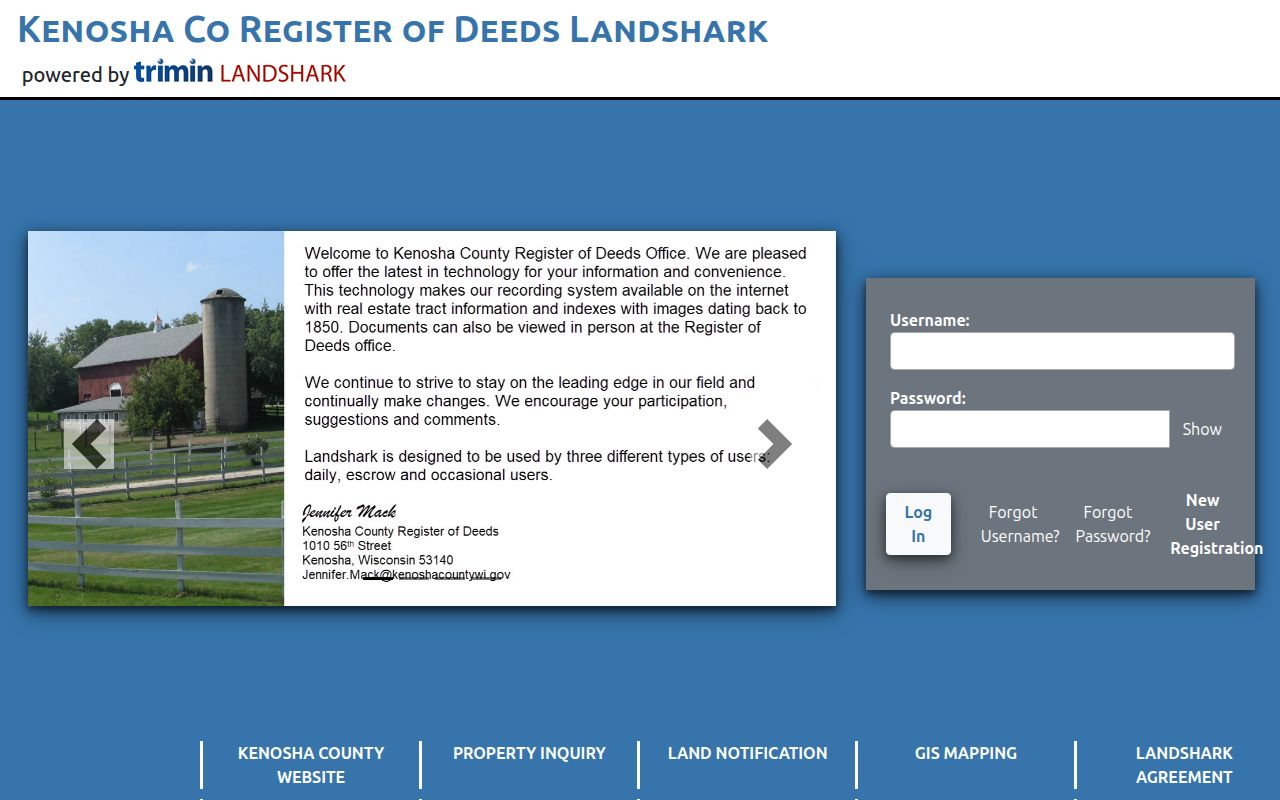
A blocked or limited portal screen is a reason to use the office channel. It is not proof the recorded document fails to exist.
Current Pleasant Prairie Resident Sources
No single office keeps a full list of who lives in Pleasant Prairie. What exists instead is a set of narrower records. Each one covers something specific. That may be property ownership, voter registration, a court case, or a licensed affiliation. Pick the record that fits your question rather than pulling everything at once. Same-name entries stay separate until at least two details line up.
| Official source | What a match can show | Keeper | Access route |
|---|---|---|---|
| Property Inquiry | Assessed owner, situs, mailing, sale, and parcel facts | Kenosha County and Village assessment | Guest portal or office |
| MyVote | Individual registration and address-based polling information | Wisconsin Elections Commission | Name and birth date, or address mode |
| LandShark | Parties to recorded land documents | Register of Deeds | Working index plus office fallback |
| WCCA | Circuit court case parties, status, and activity | Wisconsin Court System | Free index; file from clerk |
| DFI Corporate Records | Entity, agent, registered office, status, and filings | Wisconsin DFI | Public search; copies separate |
A careful Pleasant Prairie resident lookup treats each source on its own. Work them one at a time. Before linking two same-name records, wait for a second matching clue such as a street or a middle initial.
MyVote Paths for Pleasant Prairie Residents
Wisconsin MyVote gives voters two separate routes. The name route matches on first name, last name, and birth date. The address route uses street, unit, city, and ZIP code. Either one can confirm a person's own registration, voting activity, polling place, and ballot details. Ballot choices stay secret. There is no all-residents-on-a-street mode in the public interface. So this path serves individual checks rather than a street directory of neighbors.
Bulk voter rolls travel a different road. The Wisconsin Elections Commission runs that process through Badger Voters. It involves request filters, a cost estimate, payment, and protected-field exclusions. Safe at Home participants deserve special care. Their actual addresses are confidential by law. A missing address should never prompt anyone to work around that protection.
Verify Pleasant Prairie Resident Court Records
Court files answer different questions than a residents directory does. Wisconsin Circuit Court Access takes a last name, first name, middle name, birth date where allowed, business name, county, or case number. Choose Kenosha County. Then read the party role, filing date, case type, status, activity, and disposition with care. A matching name proves nothing by itself. It does not establish fault, liability, current residence, or even identity. WCCA is only an index, not a full document store.
Pleasant Prairie Municipal Court sits apart and handles Village ordinance matters. Its page offers case actions and payment routes but publishes no general public name index. For an existing municipal record, ask that court directly. The Kenosha Clerk of Circuit Court holds the underlying circuit files. WSCCA covers appeals, and PACER covers federal dockets. Jail, prison, criminal-history, and court systems each answer a different question. Compressing them into one status invites error.
Request Pleasant Prairie Resident Files
The Village public-record request page routes requests to the Clerk. It also sends them to the department that keeps the record. Phone, mail, email, and in-person requests all work. The Village quotes a ten-working-day response target, or a practical timeframe from the custodian. It also states one limit plainly. Officials need not build a new record by compiling facts that never existed in one before. That limit matters for anyone hoping a resident lookup will produce a ready-made household list.
Name the address, parcel, record type, and date range. Six departments each hold their own files. These are Building Inspection, Community Development, Engineering, Police, Public Works, and Municipal Court. The Village fee language permits charges for copies. It also allows certain reproduction, transcription, location, and delivery costs. Estimates above $5 require prepayment. Wisconsin Public Records Law, Wis. Stat. §§19.31-19.39, demands a response within a reasonable time but sets no single statewide deadline.
Note: A narrow request lands with the right custodian far more often. A demand for a brand-new list of everyone at an address does not.
Pleasant Prairie Historical Directories
Historical household work moves away from current portals and toward dated volumes. UW-Parkside lists Kenosha city and county directory holdings starting in 1858, with selected runs through 1921, odd years through 1947, selected 1950s volumes, annual volumes from 1958 through 1993, and annual volumes from 1995 through 2007 except 2004. Kenosha History Center reports city directory holdings from 1858 through 2000. Both collections lean Kenosha. Pleasant Prairie coverage must be checked volume by volume.
An entry can carry a name, a spouse or widow notation, an occupation, an employer, a street address, and later phone details. Always read that volume's abbreviation key first. Reverse street pages list adjacent households in order. Rural Pleasant Prairie families may instead appear in farmer directories keyed to PLSS section, post office, and acreage. The full shelf and reading method live in the Pleasant Prairie city directory collection.
Pleasant Prairie Resident Archive Desks
Kenosha Public Library's genealogy resources blend in-library and remote tools. Ancestry Library Edition works in the building with a library card. HeritageQuest serves up census images, directories, local histories, and other records. The library's Newspaper Archive spans the Kenosha papers from May 1945 through January 1994. It adds limited months in 2012. It also covers 2013. Those gaps matter. Any conclusion should keep them visible.
The Kenosha History Center Archives works by appointment. Its shelves hold bound newspapers from 1845 through 1945, obituaries from 1960 to the present, cemetery lists, maps and atlases, family histories, school yearbooks, and directories. Plat maps round out the shelves. UW-Parkside adds directory scans and plat maps. The Wisconsin Historical Society contributes a name index, pre-1907 vital records, images, and local-history collections. Together these sources can test a name across several forms of evidence. Past residents are included. No current address is promised.
Note: Access rules differ by collection. Record whether a result came from the public web, a card-based database, or an in-library workstation.
From Church Basement to Village
Pleasant Prairie's municipal label has shifted over time. Early town-board meetings happened in the basement of Williams Congregational Church. An 1889 move shifted gatherings from church meeting space to a town hall. The municipality today is a Wisconsin village. Some directory projects still file it under a city label. So search old records under town, village, township, post office, Kenosha County, and PLSS descriptions. Today's name will not appear on every page.
That history explains why a residents directory cannot lean on one catalog term. Early settlers may surface first in land, church, town-meeting, or county records instead. A Kenosha reference in a newspaper or directory does not always mean the City of Kenosha. Confirm the street, township, post office, spouse, occupation, and parcel before joining records across decades.
Pleasant Prairie Vital Record Split
A birth, death, marriage, or divorce certificate answers a specific question. It is not a Pleasant Prairie residents directory. Kenosha County began registering marriages in 1850. Births and deaths entered the local books in 1876. Wisconsin's statewide system starts later, on October 1, 1907. So older family events often live in county registers, church records, the Wisconsin Historical Society, or local archives instead.
Certified copies come from the Wisconsin Vital Records Office or the Kenosha Register of Deeds. They require an application, identification, and eligibility. The fee runs $20 for the first copy. It adds $3 for each extra copy of the same record ordered together. The state genealogy index works by appointment, with its own cutoffs by record type. Staff will not confirm by phone that a named record exists. Those guardrails still leave qualified family researchers a formal path. It reaches the past residents and vital entries they need.
Protected Pleasant Prairie Resident Addresses
Wisconsin Safe at Home, created under Wis. Stat. §165.68, assigns qualifying victims and household members a substitute address. Agencies then handle records so the real location stays confidential. Election and court procedures honor that assigned address. A resident lookup will also miss sealed cases. It will miss juvenile files, restricted vital records, redacted police material, and protected voter fields too.
A dead end in a residents directory rarely means bad luck. The entry may sit under a prior name. It may fall outside an online year range, live in an office-only book, or be lawfully protected. Respect that line. Ask the custodian to fix an error in your own record. Never try to reconstruct a protected address from unrelated street directory or property datasets.
Kenosha Deed Alerts in 2025
Kenosha County rolled out an enhanced Land Notification service in October 2025. Register a name or property. The county then sends free email or text alerts when a recorded document matches. It is a monitoring tool for anyone watching a parcel or deed. It is not a list of Pleasant Prairie residents.
The Register of Deeds cautions that alerts cannot stop fraud. Staff cannot catch every false filing. When one arrives, pull the actual instrument through LandShark or call the office. Check the legal description, party names, recording facts, and known ownership before concluding anything. Official records beat commercial people-finder lists here. Every field has a known custodian and a clear correction route.
| Source type | Strength | Main caution |
|---|---|---|
| Official index or file | Named custodian, defined record purpose | May be partial, dated, or subject to access limits |
| Commercial people-finder category | Can combine broad datasets | Stale links, same-name errors, unclear update timing |
| Archive collection | Strong dated context for past households | Coverage changes by year and place |
Record the date you retrieved anything, and verify important findings with the office or archive holding the source.